The torogan is the ancestral communal house of the Maranao sultan or datu. It is traditionally the largest and most prominent structure in the community, symbolizing the authority, prestige, and leadership of the ruling family. Beyond being a residence, the torogan also serves as a space for gatherings, ceremonies, and the social life of the community.
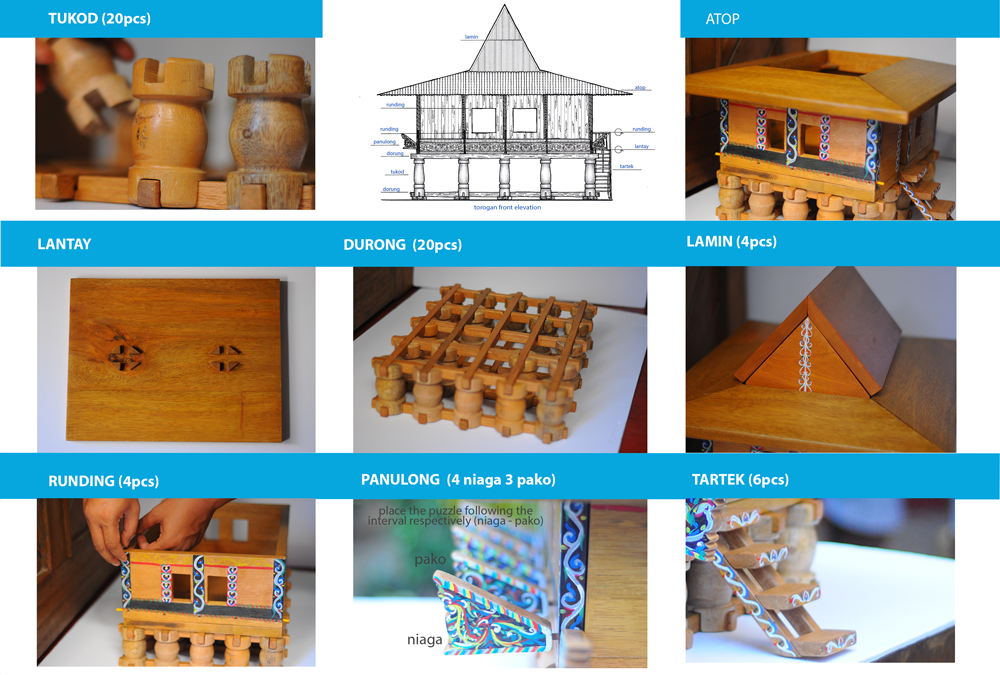
The structure is supported by massive hardwood posts called tokod, often carved from whole tree trunks. A torogan typically stands on twenty-five tokod, raising the house high above the ground. Beneath each post are six or seven carefully arranged stones called wato, which act as the foundation and help distribute the weight of the heavy structure.
The raised portion beneath the house, created by the posts and tie beams, is called the dorung. This shaded underfloor space is traditionally used for work, storage, or shelter from the heat of the day.
The second floor, known as the poro, forms the main living area. This upper level is typically an open and partitionless space where the sultan or datu and his family reside and receive guests. Access to the poro is provided by a wooden staircase called the towak.
The floor of the poro, known as the lantay, is made from thick wooden planks. These planks are supported by sturdy wooden floor joists called dolog, ensuring the strength and durability of the elevated structure.
One of the most recognizable elements of the torogan is the panolong, the large projecting beams found at the ends of the house. A torogan usually has seven to eight intricately carved panolong, which serve both structural and decorative functions. The front of the house is typically adorned with five to six panolong carved with the naga okir, a flowing serpent motif symbolizing power and protection. On the sides of the house are two panolong carved with the pako okir, a fern motif associated with growth and life.
The walls of the torogan are constructed using vertical studs called tartek, to which the dingending, or wooden wall planks, are attached. Above these are the rampatan, the roof beams that support the roofing structure.
In earlier times, torogans were roofed with atup, made from layers of cogon grass and bamboo. As materials evolved, some roofs were later built using wooden planks. During the American colonial period, galvanized iron sheets became widely used as roofing, a material that can still be seen on several surviving torogans today.
The torogan stands not only as a remarkable example of Maranao craftsmanship and engineering but also as a powerful symbol of cultural identity, leadership, and community life in Mindanao.